March Madness Format & Seeding System Explained
The NCAA Division I Men’s Basketball Tournament, commonly known as the March Madness, is one of the most exciting sporting events in the United States and the world.
Its unique format and seeding system create drama, thrills, and unpredictability, resulting in countless upsets every year.
Our expert coverage explains how March Madness works, so stay tuned and read it if you have any doubts.
NCAA March Madness Tournament Info
March Madness is a single-elimination tournament, meaning a team is eliminated after one loss. Basically, it is a knockout format, where there are no second chances, and every game is win-or-go-home, which adds more drama and tension.
Tournament Size
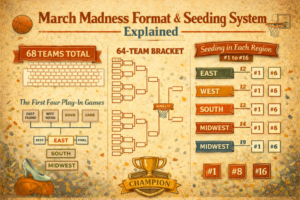
The modern tournament features 68 teams, divided into:
- 32 automatic qualifiers – Teams that win their conference tournaments
- 36 at-large bids – Teams selected by the NCAA Selection Committee
These teams compete in a six-round tournament that determines the national champion.
The “First Four” Play-In Games
Before the main bracket begins, eight teams compete in the First Four round. It is a play-in format in which the respective winners advance to the tournament brackets.
These games include:
- Four lowest-ranked automatic qualifiers
- Four lowest-ranked at-large teams
Once they are complete, the traditional tournament begins.
The 64-Team March Madness Brackets Structure
After the First Four, the tournament becomes a standard 64-team bracket, organized into four regions:
- East
- West
- South
- Midwest
Each region includes 16 teams, seeded 1 to 16. The winner of each region advances to the Final Four.
Tournament Rounds
The main rounds are:
- Round of 64
- Round of 32
- Sweet 16
- Elite Eight
- Final Four
- National Championship
Every round cuts the field in half until one team remains. It’s a typical knockout bracket.
How the Seeding System Works
What Is Seeding?
Seeding ranks teams based on their perceived strength. Each region is organized from:
- No. 1 seed, which is the strongest to
- No. 16 seed, which is the weakest
The goal is to reward top teams that were winning throughout the regular season while maintaining balanced competition.
Who and How Determines the March Madness Seeds?
The NCAA Selection Committee evaluates teams using several factors, including:
- Win-loss record
- Strength of schedule
- Quality wins and losses
- NET rankings
- Conference performance
- Injuries and roster changes
No single statistic decides seeding. Instead, the committee uses a mixture of data and expert judgment to get the final rankings. Some say it’s unfair in certain situations, but historically, this method has proven the most efficient and fair.
Typical Matchups by Seed
In the first round, teams are paired based on seed number:
- 1 vs 16
- 2 vs 15
- 3 vs 14
- 4 vs 13
- 5 vs 12
- 6 vs 11
- 7 vs 10
- 8 vs 9
These matchups are designed to give higher seeds an advantage. However, upsets are common, and sometimes teams with very long odds to win the March Madness went all the way, like the NC State Wolfpack in 1983 or the Villanova Wildcats in 1985.
Regional Placement and Geography
The committee also considers geography when building the bracket.
Whenever possible:
- Teams are placed closer to home
- Travel is minimized
- Conference rivals are separated early
All this helps reduce travel fatigue and avoids repeat matchups in early rounds.
Why Seeding Matters
Seeding affects a team’s entire tournament path.
Higher seeds usually benefit from:
- Easier early matchups
- Favorable locations
- Lower travel demands
Lower seeds face tougher opponents but often play with less pressure, leading to Cinderella runs that define the NCAA Tournament. Throughout history, we’ve seen teams beating the March Madness odds and going all the way, creating one of the most beautiful stories in sports.
Common March Madness Seeding Trends
Historically, there have been certain patterns characteristic for the NCAA Tournament.
- No. 1 seeds reach the Final Four most often
- No. 16 seeds rarely win (but it has happened)
- No. 12 seeds frequently upset No. 5 seeds
- No. 8 vs No. 9 games are nearly even
These trends are popular among fans and bettors when filling out March Madness brackets.
Final Thoughts
The March Madness format and seeding system are designed to balance fairness with excitement. By combining automatic bids, expert rankings, regional brackets, and single-elimination drama, the NCAA creates one of the most unpredictable tournaments in all of sports.
Understanding how teams are selected and seeded helps fans make better brackets, smarter bets, and deeper connections to the tournament. Every March, this structure ensures that anything can happen, bringing joy and thrill to millions of fans across the US and worldwide.