March Madness Winners by Year
The NCAA Division I Men’s Basketball Tournament, better known as March Madness, is one of the most popular sporting events in the United States. Its blend of tradition, drama, and unpredictability has made it a cultural institution.
Here’s how the tournament guide throughout history.
NCAA Tournament Champions: Finals Results, Opponents, and Venues (1939–present)
| Year | Champion | Final Score | Runner-Up | Venue (City, State) |
|---|---|---|---|---|
| 2025 | Florida | 65–63 | Houston | Alamodome, San Antonio, TX |
| 2024 | Connecticut | 75–60 | Purdue | State Farm Stadium, Glendale, AZ |
| 2023 | Connecticut | 76–59 | San Diego State | NRG Stadium, Houston, TX |
| 2022 | Kansas | 72–69 | North Carolina | Caesars Superdome, New Orleans, LA |
| 2021 | Baylor | 86–70 | Gonzaga | Lucas Oil Stadium, Indianapolis, IN |
| 2020 | — | — | — | Canceled |
| 2019 | Virginia | 85–77 OT | Texas Tech | U.S. Bank Stadium, Minneapolis, MN |
| 2018 | Villanova | 79–62 | Michigan | Alamodome, San Antonio, TX |
| 2017 | North Carolina | 71–65 | Gonzaga | University of Phoenix Stadium, Glendale, AZ |
| 2016 | Villanova | 77–74 | North Carolina | NRG Stadium, Houston, TX |
| 2015 | Duke | 68–63 | Wisconsin | Lucas Oil Stadium, Indianapolis, IN |
| 2014 | Connecticut | 60–54 | Kentucky | AT&T Stadium, Arlington, TX |
| 2013 | Louisville (vacated) | 82–76 | Michigan | Georgia Dome, Atlanta, GA |
| 2012 | Kentucky | 67–59 | Kansas | Superdome, New Orleans, LA |
| 2011 | Connecticut | 53–41 | Butler | Reliant Stadium, Houston, TX |
| 2010 | Duke | 61–59 | Butler | Lucas Oil Stadium, Indianapolis, IN |
| 2009 | North Carolina | 89–72 | Michigan State | Ford Field, Detroit, MI |
| 2008 | Kansas | 75–68 OT | Memphis | Alamodome, San Antonio, TX |
| 2007 | Florida | 84–75 | Ohio State | Georgia Dome, Atlanta, GA |
| 2006 | Florida | 73–57 | UCLA | RCA Dome, Indianapolis, IN |
| 2005 | North Carolina | 75–70 | Illinois | Edward Jones Dome, St. Louis, MO |
| 2004 | Connecticut | 82–73 | Georgia Tech | Alamodome, San Antonio, TX |
| 2003 | Syracuse | 81–78 | Kansas | Superdome, New Orleans, LA |
| 2002 | Maryland | 64–52 | Indiana | Georgia Dome, Atlanta, GA |
| 2001 | Duke | 82–72 | Arizona | Metrodome, Minneapolis, MN |
| 2000 | Michigan State | 89–76 | Florida | RCA Dome, Indianapolis, IN |
| 1999 | Connecticut | 77–74 | Duke | Tropicana Field, St. Petersburg, FL |
| 1998 | Kentucky | 78–69 | Utah | Alamodome, San Antonio, TX |
| 1997 | Arizona | 84–79 OT | Kentucky | RCA Dome, Indianapolis, IN |
| 1996 | Kentucky | 76–67 | Syracuse | Meadowlands Arena, NJ |
| 1995 | UCLA | 89–78 | Arkansas | Kingdome, Seattle, WA |
| 1994 | Arkansas | 76–72 | Duke | Charlotte Coliseum, NC |
| 1993 | North Carolina | 77–71 | Michigan | Superdome, New Orleans, LA |
| 1992 | Duke | 71–51 | Michigan | Metrodome, Minneapolis, MN |
| 1991 | Duke | 72–65 | Kansas | Hoosier Dome, Indianapolis, IN |
| 1990 | UNLV | 103–73 | Duke | Denver, CO |
| 1989 | Michigan | 80–79 OT | Seton Hall | Seattle, WA |
| 1988 | Kansas | 83–79 | Oklahoma | Kansas City, MO |
| 1987 | Indiana | 74–73 | Syracuse | New Orleans, LA |
| 1986 | Louisville | 72–69 | Duke | Dallas, TX |
| 1985 | Villanova | 66–64 | Georgetown | Lexington, KY |
| 1984 | Georgetown | 84–75 | Houston | Seattle, WA |
| 1983 | NC State | 54–52 | Houston | Albuquerque, NM |
| 1982 | North Carolina | 63–62 | Georgetown | New Orleans, LA |
| 1981 | Indiana | 63–50 | North Carolina | Philadelphia, PA |
| 1980 | Louisville | 59–54 | UCLA | Indianapolis, IN |
| 1979 | Michigan State | 75–64 | Indiana State | Salt Lake City, UT |
| 1978 | Kentucky | 94–88 | Duke | St. Louis, MO |
| 1977 | Marquette | 67–59 | North Carolina | Atlanta, GA |
| 1976 | Indiana | 86–68 | Michigan | Philadelphia, PA |
| 1975 | UCLA | 92–85 | Kentucky | San Diego, CA |
| 1974 | NC State | 76–64 | Marquette | Greensboro, NC |
| 1973 | UCLA | 87–66 | Memphis State | St. Louis, MO |
| 1972 | UCLA | 81–76 | Florida State | Los Angeles, CA |
| 1971 | UCLA | 68–62 | Villanova | Houston, TX |
| 1970 | UCLA | 80–69 | Jacksonville | College Park, MD |
| 1969 | UCLA | 92–72 | Purdue | Louisville, KY |
| 1968 | UCLA | 78–55 | North Carolina | Los Angeles, CA |
| 1967 | UCLA | 79–64 | Dayton | Louisville, KY |
| 1966 | Texas Western (UTEP) | 72–65 | Kentucky | College Park, MD |
| 1965 | UCLA | 91–80 | Michigan | Portland, OR |
| 1964 | UCLA | 98–83 | Duke | Kansas City, MO |
| 1963 | Loyola (IL) | 60–58 OT | Cincinnati | Louisville, KY |
| 1962 | Cincinnati | 71–59 | Ohio State | Louisville, KY |
| 1961 | Cincinnati | 70–65 OT | Ohio State | Kansas City, MO |
| 1960 | Ohio State | 75–55 | California | San Francisco, CA |
| 1959 | California | 71–70 | West Virginia | Louisville, KY |
| 1958 | Kentucky | 84–72 | Seattle | Louisville, KY |
| 1957 | North Carolina | 54–53 3OT | Kansas | Kansas City, MO |
| 1956 | San Francisco | 83–71 | Iowa | Evanston, IL |
| 1955 | San Francisco | 76–73 | La Salle | Kansas City, MO |
| 1954 | La Salle | 92–76 | Bradley | Kansas City, MO |
| 1953 | Indiana | 69–68 | Kansas | Kansas City, MO |
| 1952 | Kansas | 80–63 | St. John’s | Seattle, WA |
| 1951 | Kentucky | 68–58 | Kansas State | Minneapolis, MN |
| 1950 | CCNY | 71–68 | Bradley | New York, NY |
| 1949 | Kentucky | 46–36 | Oklahoma A&M | Seattle, WA |
| 1948 | Kentucky | 58–42 | Baylor | New York, NY |
| 1947 | Holy Cross | 58–47 | Oklahoma | New York, NY |
| 1946 | Oklahoma A&M | 43–40 | North Carolina | New York, NY |
| 1945 | Oklahoma A&M | 49–45 | NYU | New York, NY |
| 1944 | Utah | 42–40 OT | Dartmouth | New York, NY |
| 1943 | Wyoming | 46–34 | Georgetown | New York, NY |
| 1942 | Stanford | 53–38 | Dartmouth | Kansas City, MO |
| 1941 | Wisconsin | 39–34 | Washington State | Kansas City, MO |
| 1940 | Indiana | 60–42 | Kansas | Kansas City, MO |
| 1939 | Oregon | 46–33 | Ohio State | Evanston, IL |
Early Beginnings (1939–1950s)
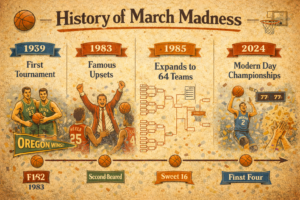
March Madness began in 1939 with just 8 teams competing for a national title. The first tournament was organized by the National Association of Basketball Coaches, and the University of Oregon won the inaugural championship.
In its early years, the NCAA tournament received little national attention. College football dominated American sports, and basketball was still growing in popularity. Games were mostly regional, and media coverage was limited, which was in fact the biggest reason for this.
However, as more universities embraced basketball, interest in the tournament steadily increased.
Expansion and Growth (1960s–1970s)
During the 1960s and 1970s, the NCAA tournament began expanding:
- 25 teams in 1975
- 32 teams in 1979
This expansion allowed more conferences to participate and increased national appeal. In 1979, the championship game between Magic Johnson and Larry Bird became a turning point. It remains one of the most-watched college basketball games in history which helped launch college basketball into the mainstream.
Television coverage also improved during this era, bringing March Madness into living rooms across the United States.
The Birth of “March Madness” (1980s)
The term “March Madness” became widely used in the 1980s, as the tournament’s popularity exploded.
In 1985, the field expanded to 64 teams, creating the bracket structure still used today. That same year, Villanova shocked Georgetown as an eighth seed, proving that underdogs could win it all. It was one of the iconic Cinderella runs.
This era established the tournament’s reputation for:
- Upsets
- Cinderella stories
- Buzzer-beaters
- Emotional finishes
These elements turned March Madness into must-watch television, and suddenly the NCAA basketball was mega popular.
Modern Era and National Obsession (1990s–2000s)
By the 1990s, March Madness had become a national obsession.
Office pools, bracket contests, and media coverage grew rapidly. Fans who rarely watched college basketball during the season tuned in every March.
The tournament expanded again in 2001 to 65 teams, later reaching 68 teams in 2011. This introduced the “First Four” play-in games.
During this period, legendary programs and coaches built dynasties, while dramatic moments, such as last-second shots and unexpected champions, cemented the tournament’s legacy.
Digital Age and Global Reach (2010s–Present)
In the 2010s and beyond, March Madness entered the digital age.
Fans now follow games through:
- Streaming platforms
- Mobile apps
- Social media
- Live analytics
Bracket challenges attract tens of millions of entries each year, making them among the largest prediction contests in the world. The tournament’s reach has also become more global, with international viewers and players contributing to its popularity.
Iconic Moments in March Madness History
Some defining moments include:
- No.16 UMBC Upsets No.1 Virginia (2018)
- Magic Johnson vs. Larry Bird (1979)
- Villanova’s Championship Buzzer-Beater (2016)
- Christian Laettner’s Buzzer-Beater (1992)
- 1983 NC State Wolfpack and 1985 Villanova Wildcats championship runs
These moments are replayed every year and keep the tournament’s history alive.
Why March Madness Endures
March Madness remains special because it combines:
- Single-elimination pressure
- Equal opportunity for small schools
- National attention
- Emotional storytelling
Unlike many professional leagues, every team starts with the same goal and the same chance—win six games and become champion.
Final Thoughts
From an eight-team tournament in 1939 to a 68-team national spectacle, March Madness has evolved into one of the most celebrated events in sports. Its history is filled with unforgettable players, shocking upsets, and legendary moments.
Each March, the tournament adds new chapters to its story—proving that in college basketball, anything is possible.